Connecticut Lawmakers Push Bill Requiring School Boards to Justify Book Bans
As the nationwide book ban debate grows, Connecticut lawmakers have proposed new procedures for school Boards of Education to follow that would require them to give a reason to block books.
Under a proposed law, local and regional school boards will need to provide a reason for removing or restricting certain materials from public school libraries, according to the general assembly. If signed into law, it will take effect July 1st.
“We’re drafting updated language to make it very clear that this is all based on age and developmental appropriateness,” Rep. Jeff Currey, D-East Hartford said.
The bill states six reasons for why a book cannot be removed. For instance, an author’s race, nationality, gender identity, sexual orientation or political or religious views is not a valid reason for restricting materials, according to the general assembly website.
The Free Speech Center outlines that those who advocate for book bans typically complain that the books contain graphic violence, are sexually explicit, are racist, or use offensive language among other sensitive themes.
Library Media Specialist at William J. Johnston Middle School in Colchester, Michele Lane, explained that books need to go through background checks before being added to school libraries.
“Each school library in Connecticut has/should have a certified librarian who follows a set book selection process,” Lane said. “In Colchester, any book I consider for selection has to be vetted, looking at three professional reviews of the material.”
The first U.S. Supreme Court case regarding the banning of books, Board of Education, Island Trees Union Free School District No. 26 v Pico, lays the groundwork for the new Connecticut bill, Currey said. The court concluded in a 5-4 decision that banning certain books violates the First Amendment’s freedom of speech protections, according to Oyez.
“Nobody should be able to place any sort of restriction around that,” Currey said.
According to the 2023 data compiled by the American Library Association, there were 17 attempts to restrict access to books, for a total of 113 challenged titles. Nationally, the ALA’s Office for Intellectual Freedom compiled 1,247 demands to censor library books and resources in 2023.
After a long-winded debate in 2023, the Newtown Board of Education voted against banning “Flamer” by Mike Curato and “Blankets” by Craig Thompson, Superintendent of Schools Christopher Melillo said. Both books contain graphic depictions of sexual themes that parents may not want their children to be exposed to.
Newtown serves close to 4,000 students and it’s difficult for any school system to abide by each student’s values and beliefs, Melillo said. According to data collected by ALA, the majority of challengers are patrons and parents who aim to restrict their children’s exposure to particular books and library resources.
“Asking the school system to apply individual morals on everyone else keeps materials from getting to the greater population,” Melillo said.
Teen librarian of Southington Public Library, Nicole Kent, said that attempts to ban books is controlling what people are allowed to read and think.
“If you don’t have access to a variety of materials, you can’t get a variety of viewpoints,” Kent said.
Connecticut lawmakers held a listening session with librarians on Dec. 5, 2023 to discuss the struggles that librarians are facing with book ban numbers rising.
“It’s a very different conversation in the public school arena than it is in a public library arena,” Currey said.
He added that people often forget that there is a tedious process for replacing books within schools and the Connecticut Education Committee is introducing legislation that allows for more local control.
“We would require boards of education at the local and regional level to develop policies around how to handle a challenge made by a parent, guardian or a student,” Currey said.
Melillo said that books should be observed in totality, rather than in small pieces taken out of context. He added that debates become dicey when they are rooted in misconstrued quotes and images that are pulled from the entirety of the literature.
Some public school educators also hold concerns surrounding the book ban debate.
“Increasingly limiting the books people can read risks removing those opportunities for people to see themselves reflected in literature and to learn about the world beyond themselves,” Rocky Hill High School English Teacher Jillian Barry said.
William J. Johnston Middle School English Teacher Lisa Lackey says kids should be allowed to think for themselves.
“If we ban books, we are banning entire populations of kids who find a connection to characters who are like them,” Lackey said. “Let's not put the views of a few citizens over the needs of the many.”
School libraries saw an 11 percent increase of titles targeted for censorship in 2023 as opposed to 2022 numbers, the ALA reports.
When speaking on media materials in Newtown schools, Melillo said they should act as windows and mirrors for the students to see themselves in.
One high school student in Colchester, Aubrey Nosal, said she finds comfort in the relatability of literature.
“I enjoy reading books because I can relate to the characters and it helps me know I'm not alone,” Nosal said.
Not only are public school libraries affected by book bans, but libraries open to the general public are vulnerable to challenges as well. Kate Byroade, director of Cragin Memorial Library of Colchester, said one of their titles, “Who is RuPaul?” was publicly challenged in 2022.
“A library is here to serve the whole community,” Byroade said. “If people are not comfortable with everything in the library, then I am probably doing a good job at serving the whole community.”
Byroade said that libraries should contain books suited for all spectrums of the community.
David McGuire, the executive director of the American Civil Liberties Union of Connecticut reacted to the Colchester challenge, saying that everyone has a right to read and learn free from viewpoint-based censorship, and young people have a First Amendment right to read and learn about the history and viewpoints of all communities in our libraries, according to the ACLU of Connecticut.
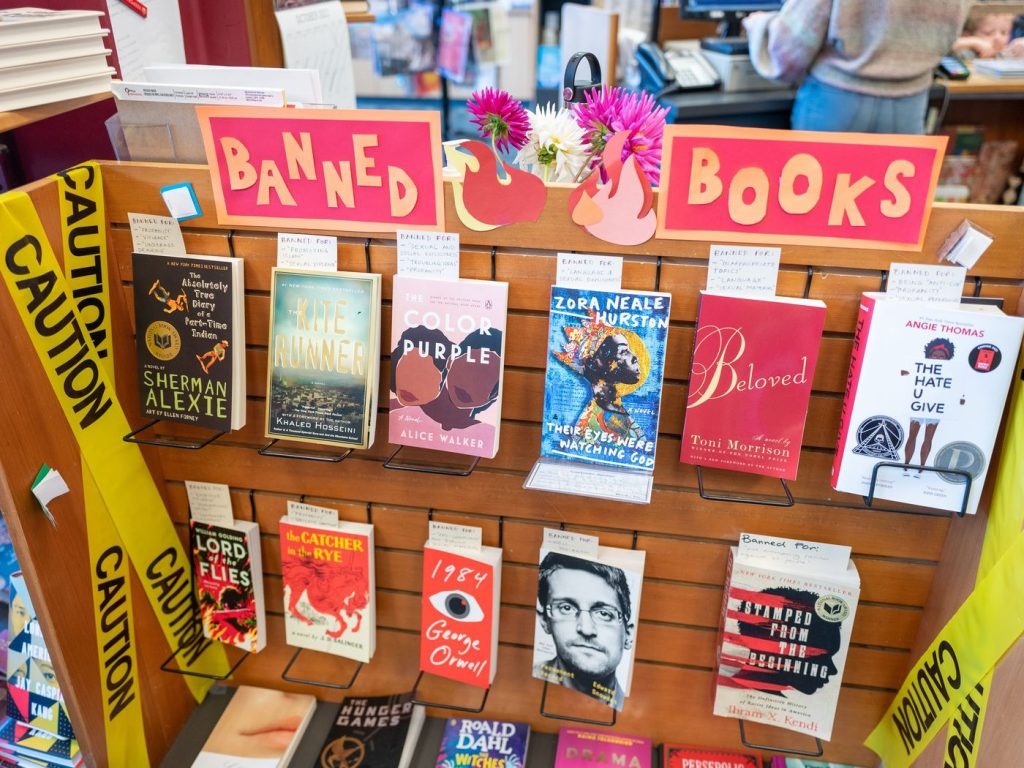
Libraries across Connecticut recognize banned books by putting out displays of challenged titles. The Cragin Memorial Library presents its display in the fall every year, Byroade said.
“People are very often surprised at the books that have been challenged,” Byroade said.
An example of a surprising title is Mark Twain’s “Adventures of Huckleberry Finn.” The Free Speech Center said that the book may be described as racist, irreligious and mindless among other concerns.
The First Amendment right is a common denominator in arguments relating to why books should not be banned. People may exercise their right to freedom of expression by reading literature tailored to their unique beliefs and values.
“Everybody is represented in a book,” Currey said. “You can find at least one piece of literature in which one of us is found.”
0 Comments Add a Comment?